We deliver local knowledge backed by global strength.
With presence across the continents, we enable our member firms to deliver services that are locally relevant and globally aligned with international standards.

Our Network
Our Network

Insights
Insights
Business Insights providing executives with straightforward and strategic perspectives on key challenges: reshaping business models, addressing climate change and sustainability, and cultivating trust amidst rapid technological advancements.
All Insights
Services
Services
Our collaborative and transparent service portfolio includes assurance, business advisory, tax compliance and planning, risk assessment, and technology services. We prioritize integrity, objectivity, and confidentiality. With personalized strategies, we excel in meeting diverse client needs through a client-centric and proactive approach.
All Services
Industries
Industries
At PA Global, we stand as your reliable partner in navigating today’s complex and evolving business landscape. Our team of seasoned professionals brings deep industry expertise and a commitment to delivering tailored, forward-thinking solutions that empower organizations to grow sustainably and operate with resilience.
All Industries


 PA Academy
 Members Portal
Continuous Improvement in Auditing: Linking PFCR with ISQM 1 for Lasting Quality
29 DEC 2025
Assurance
Reporting Standards
Strategy
Continuous Improvement as a Mindset
Continuous improvement is one of the most enduring principles of quality management. It traces back to W. Edwards Deming (1900–1993), the American statistician and management visionary whose Plan–Do–Check–Act (PDCA) cycle reshaped modern management systems.
Deming’s philosophy emphasized that quality is not an end state but a perpetual process of learning, feedback, and refinement.
Although the model was originally developed for manufacturing, its underlying principles have since transcended diverse sectors. In professional services, and particularly in auditing, it carries profound relevance.
Every audit engagement, by its nature, involves judgment, evidence, and communication, all of which are subject to continual refinement.
Auditors operate in a world defined by complexity, regulation, and expectation. To preserve public confidence, audit quality cannot rely solely on compliance checklists; it must evolve through continuous improvement.
Philosophy and Essence of the PFCR Audit Model
Recognizing the need for an audit-specific model and building on Deming’s legacy, Dr. Daoud Y. Sobh, a Lebanese academic, author, and audit expert, adapted the PDCA concept to the auditing profession through the “PFCR Audit Continuous Improvement Cycle” leading to the development of the PFCR Audit Model: Planning → Fieldwork → Completion → Reporting.
More than a procedural sequence, The PFCR Model represents a mindset of continuous improvement, integrating quality into every stage of the engagement. Through this model, Dr. Sobh established a bridge between quality theory and professional audit practice, ensuring that audit quality is not a mere exercise in procedural compliance, but a living and evolving discipline of excellence.
The PFCR Model captures the rhythm of an audit engagement, with each phase building on the previous one and a feedback loop that drives learning and quality enhancement for future engagements. Dr. Sobh’s adaptation of Deming’s PDCA into the PFCR Model operationalizes the principle of continuous improvement within the practical realities of the audit process.
Anchored in quality at every stage, the PFCR Model positions audit quality as a central driver rather than a final checkpoint. It integrates the requirements of the International Standards on Auditing (ISAs) and International Standards on Quality Management (ISQM 1 and 2), ensuring that quality management principles are embedded throughout the engagement cycle.
The PFCR Model is therefore not theoretical; it is a practical and standards-aligned model that transforms the audit process into a continuous improvement system, consistent, adaptive, and progressively stronger over time.
Planning: Setting the Tone
The foundation of every effective audit lies in planning—understanding the client, assessing risks, defining materiality, and developing an audit strategy. It is during this stage that tone, accountability, and quality objectives are established, anticipating where the greatest risks and opportunities for improvement lie.
In the PFCR Model, planning is not merely procedural; it defines the tone, accountability, and expected quality for the entire engagement.
Fieldwork: Executing with Discipline
Fieldwork converts strategy into action through tests of controls, substantive procedures, and analytical reviews. Supervision, adaptability, and professional skepticism ensure that procedures remain evidence-driven and responsive to emerging findings.
The fieldwork phase represents real-time learning and continuous monitoring. Auditors adjust their approach based on findings, ensuring adaptability rather than rigidity.
Completion: Reflecting and Validating
This stage consolidates conclusions and evaluates whether sufficient and appropriate evidence supports the opinion.
It involves reassessing risks, evaluating misstatements, reviewing subsequent events, and confirming compliance with ethical and technical standards. Equally important, the completion phase captures lessons learned and identifies areas for improvement in future engagements.
Reporting: Communicating and Closing the Loop
Reporting finalizes the engagement through transparent communication. Beyond issuing the auditor’s report, this phase also includes communicating internal control deficiencies, preparing management letters, and completing documentation in accordance with professional standards.
Insights from reviewers, regulators, and clients feed directly into the next planning phase, closing the loop and sustaining the cycle of continuous improvement.
The Feedback Loop: Turning Experience into Improvement
The defining strength of PFCR Model lies in its structured feedback system. Each audit generates learning that informs future engagements. Review notes, inspection results, and client feedback are analyzed to identify recurring issues and root causes.
This structured reflection transforms isolated engagements into a collective learning ecosystem, where the firm’s quality continuously evolves.
PFCR and ISQM 1 in Action
PFCR translates the International Standard on Quality Management 1 (ISQM 1) into day-to-day audit practice, illustrating how quality management principles naturally unfold throughout the engagement cycle. Governance and leadership are reflected in the Planning phase, where tone, accountability, and quality objectives are defined. The Risk Assessment process extends across Planning and Fieldwork, guiding auditors to identify, evaluate, and respond to quality risks in real time.
During Fieldwork, ISQM 1’s focus on resources, and performance becomes evident through competence, supervision, and disciplined execution. The principles of Information and Communication are expressed during the Completion and Reporting phases, ensuring documentation, transparency, and shared learning. Finally, Monitoring and Remediation are institutionalized through the PFCR feedback loop, which captures lessons learned and drives firm-wide enhancement.
Together, ISQM 1 establishes the system of quality, while PFCR delivers its execution; turning policy into performance and performance into continuous improvement.
Quality as a Living Discipline
Auditing, like the environment it serves, evolves constantly. Standards change, risks shift, and technology redefines how evidence is gathered and analyzed. In this environment, continuous improvement is not an option, it is the only path to relevance and reliability.
By embracing the PFCR model within ISQM 1 principles, audit firms convert compliance into progress. Each engagement becomes an opportunity to refine methodology, strengthen professional judgment, and reinforce confidence in assurance.
Quality, therefore, is not a destination but a discipline, renewed with every audit, every reflection, and every lesson learned. The PFCR Model embodies this truth: quality must be built in, not merely inspected in. Through its interconnected phases and feedback loop, PFCR transforms auditing into a living process of excellence, where every audit is stronger than the last.
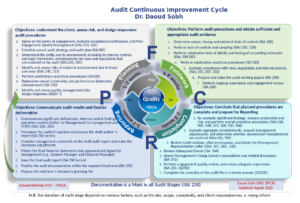
The PFCR Audit Continuous Improvement Cycle (Dr. Daoud Y. Sobh, updated August 2025)
The PFCR Model transforms auditing into a continuous improvement system, where phases are interconnected through a structured feedback loop. Each phase strengthens the next, embedding quality, learning, and accountability across the entire engagement cycle in alignment with ISQM 1 and ISA standards.
© 2026 PA Global. All rights reserved.