We deliver local knowledge backed by global strength.
With presence across the continents, we enable our member firms to deliver services that are locally relevant and globally aligned with international standards.

Our Network
Our Network

Insights
Insights
Business Insights providing executives with straightforward and strategic perspectives on key challenges: reshaping business models, addressing climate change and sustainability, and cultivating trust amidst rapid technological advancements.
All Insights
Services
Services
Our collaborative and transparent service portfolio includes assurance, business advisory, tax compliance and planning, risk assessment, and technology services. We prioritize integrity, objectivity, and confidentiality. With personalized strategies, we excel in meeting diverse client needs through a client-centric and proactive approach.
All Services
Industries
Industries
At PA Global, we stand as your reliable partner in navigating today’s complex and evolving business landscape. Our team of seasoned professionals brings deep industry expertise and a commitment to delivering tailored, forward-thinking solutions that empower organizations to grow sustainably and operate with resilience.
All Industries


 PA Academy
 Members Portal
Consulting Firms in the AI Era: From Thinkers to Doers
7 JAN 2026
Advisory
AI
Digital Adoption and Transformation
Management
Strategy
Did you know that consulting firms are investing billions in AI to transform how businesses operate?
Consulting firms have long been the architects of corporate strategy, operational efficiency and organizational transformation. From their origins in the early 20th century to their current AI-enhanced models, the role of consultants has undergone a profound transformation. Today, consulting firms are not just advisors, they are execution partners, technology enables and change agents.
The Classic Advisory Model
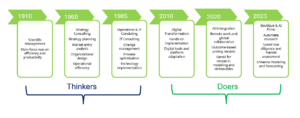
Consulting firms have long been trusted advisors to businesses. For decades, they have played a pivotal role in shaping the strategic direction of businesses across industries. Traditionally, their value lay in offering expert advice, strategic insights, analytical frameworks, and high-level recommendations. Consulting firms like McKinsey & Co, BCG , Accenture, IBM, Bain & Company and many others built their reputations by helping their clients overcome complex challenges through structured thinking and strategic insight.
During those early phases, consultants operated primarily as external advisors with a traditional role consisting of delivering reports and presentations (strategic planning, market analysis and entry str, organizational design, operational optimization…) that clients would implement themselves.
Consultants were primarily engaged to solve complex business problems using frameworks like
- SWOT analysis: a strategic planning tool that evaluates a company’s internal Strengths and Weaknesses and external Opportunities and Threats
- BCG matrix : a portfolio management framework that categorizes business units or products into four quadrants (Stars, Cash Cows, Question Marks, and Dogs) based on market share and growth;
- Porter’s Five Forces: an industry competitiveness assessment through rivalry, supplier power, buyer power, threat of substitution, and threat of new entrants (strategic tools to evaluate business portfolio).
Their value lay in analytical rigor and industry expertise. The relationship between the consulting firms and their clients was largely intellectual and advisory based, with consultants positioned as thinkers rather than doers.
The Shift From Advice to Action
As the business landscape grew more competitive and technology began to disrupt traditional models, the expectations placed on consulting firms began to shift. By the early 2000s, clients were no longer satisfied with theoretical strategies and recommendations; they wanted measurable and tangible results[1]. This marked a significant transformation in the consulting model: From Advice to Action.
BBVA Bank partnered with Accenture to reinvent its customer experience using AI and digital tools, reaching nearly 50 million customers through enhanced digital channels. This illustrates how consulting evolved from strategy to hands-on execution[2].
Consulting firms began expanding their capabilities to include implementation services, change management and digital transformation. Consultants were increasingly embedded within client organizations, working side-by-side with internal teams to execute strategies, manage transitions, and deliver measurable outcomes. Clients began demanding not just advice but hands-on implementation. This led to hybrid models where strategy and execution were integrated.
The consulting engagement evolved into a partnership, where firms were not just telling clients what to do, they were helping them do it.
The shift from “tell us what to do” to “help us do it”
The AI-Powered Consulting Era
This shift became even more pronounced in the 2020s, as digital transformation accelerated and artificial intelligence (AI) began reshaping industries. The key drivers that contributed to this shift were mainly due to global competition along with the demand for faster execution.
Consequently, consulting firms had to adapt quickly to the complexity of this change by building implantation team, integrating AI tools into their workflows to enhance efficiency, speed, and precision. Tasks that once took days, such as market research, data analysis, and report generation, could now be completed in hours using generative AI and predictive analytics.
Consulting firms began restructuring their internal models, moving away from the traditional pyramid hierarchy toward flatter, more agile teams. New roles emerged, such as AI facilitators and digital transformation leads, reflecting the growing importance of technology in consulting delivery.
Human and Machine Collaboration
Despite the rise of automation, the human element in consulting remains irreplaceable. While AI is profoundly reshaping the consulting industry, not by replacing consultants, but by transforming how they work. AI automates many routine and labor-intense tasks traditionally handled by junior consultants mainly, it can process data, create financial modeling, summarize documents and generate insights.
However, AI cannot replicate the strategic judgement, creativity, and interpersonal skills that consultants bring to the table, leading to organizational change. Clients still rely on consultants for their ability to lead change, build consensus, and navigate organizational dynamics.
In fact, the most successful consulting firms today are those that blend technological capabilities with human expertise, leveraging AI to enhance, not replace, the consultant’s role.
Real-world examples illustrate this evolution clearly. McKinsey has integrated AI into its due diligence processes, enabling faster and more accurate assessments. McKinsey launched Lilli, a generative AI tool used by 72% of its consultants to cut research time by 30%, enabling faster due diligence and deeper insights[1]. As another example, Deutsche Telekom & McKinsey – Built AI-powered training tools for employees, boosting productivity and engagement
Accenture offers cloud-native transformation services that combine technology platforms with strategic consulting. Best Buy & Accenture implemented a generative AI-powered virtual assistant to enhance customer support, reducing wait times and improving satisfaction[2].
While traditional consulting giants are integrating AI into their services, boutique firms like Quantiphi (AI-first digital engineering and consulting company that specializes in generative AI, cloud and data driving transformation) and Turing (originally a remote engineering talent platform has evolved into a full-fledged AI-powered tech consulting firm) are gaining tractions by offering AI-first models, automating research and predictive analytics to deliver speed and cost-efficiency, and innovation challenging the dominance of traditional players[3].
Despite automation, human judgement remains irreplaceable. AI handles data-heavy tasks, but consultants lead change and navigate organization dynamic
New Business Models and Client Expectations
Consulting firm today deliver a wide range of outcomes that go far beyond traditional strategy advice. Their impact is now measured in tangible business results, technology adoption and organizational transformation. With this shift comes the risks and ethical considerations such as AI hallucinations that can lead to errors in client deliverables. For precautionary reasons, consulting firms are enforcing strict AI usage policies to ensure accountability and accuracy.
Client expectations have also evolved. Today’s clients demand transparency, agility, and accountability. They expect consultants to be embedded in their operations, co-creating solutions and delivering outcomes, not just advice. Pricing models have shifted from hourly billing to value-based arrangements, where compensation is tied to results. Procurement departments now play a larger role in selecting consulting partners, emphasizing return on investment and measurable impact.
Aviva Insurance, one of UK larger insurer, rewired its claims journey by deploying 80+ AI models. The initiative aimed to improve outcomes at every step by embedding advanced AI tools to help claim professionals make faster and more accurate decisions, and hence, improving customer experience[4].
Future Outlook: Ecosystem Orchestrators
In this new era, consulting firms are no longer just advisors, they are ecosystem orchestrators. They bring together technology, talent, and strategy to drive transformation at scale. To remain competitive, firms must continuously reskill their workforce, invest in proprietary tools, and foster a culture of innovation. The consulting industry is at a crossroads, and those who embrace the shift from advice to action, powered by AI and human ingenuity, will shape the future of business. Those who adapt will not only survive, they will lead.
[1] Harvard Business Review article “Consulting on the Cusp of Disruption” by Clayton M. Christensen, Dina Wang, and Derek van Bever (October 2013).
[2] Top 10 AI Consulting Firms for Your Business 2025 [Updated List]
[1] Five ways to improve due diligence using gen AI | McKinsey
[2] Reinventing M&A with Generative AI | Accenture
[3] AI in Big Consulting: What the Large Players Are All Doing in 2025
[4] Aviva: Rewiring the insurance claims journey with AI | Tech and AI | McKinsey & Company
© 2026 PA Global. All rights reserved.