We deliver local knowledge backed by global strength.
With presence across the continents, we enable our member firms to deliver services that are locally relevant and globally aligned with international standards.

Our Network
Our Network

Insights
Insights
Business Insights providing executives with straightforward and strategic perspectives on key challenges: reshaping business models, addressing climate change and sustainability, and cultivating trust amidst rapid technological advancements.
All Insights
Services
Services
Our collaborative and transparent service portfolio includes assurance, business advisory, tax compliance and planning, risk assessment, and technology services. We prioritize integrity, objectivity, and confidentiality. With personalized strategies, we excel in meeting diverse client needs through a client-centric and proactive approach.
All Services
Industries
Industries
At PA Global, we stand as your reliable partner in navigating today’s complex and evolving business landscape. Our team of seasoned professionals brings deep industry expertise and a commitment to delivering tailored, forward-thinking solutions that empower organizations to grow sustainably and operate with resilience.
All Industries


 PA Academy
 Members Portal
The International Foundation for Ethics and Audit (IFEA) is a nonprofit organization established to support high‑quality international standard‑setting in ethics, audit, and assurance in the public interest. [ethicsandaudit.org]
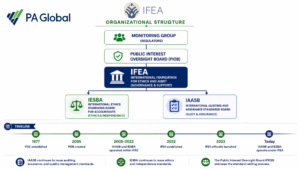
The IFEA was launched as a response to recommendations made by the Monitoring Group (MG) in 2020, which aimed to improve the governance and independence of international audit and ethics standards. The foundation officially began its operations in October 2022, taking over the responsibilities of the International Auditing and Assurance Standards Board (IAASB) and the International Ethics Standards Board for Accountants (IESBA), which were previously part of IFAC.
Created as part of global reforms to strengthen independence in standard‑setting, IFEA plays a central role in ensuring that global ethics and auditing standards are developed through a robust, transparent, and public‑interest‑focused process. [prudentchartered.com]
IFEA’s Global Role & Purpose
IFEA’s mission is to support the development of high‑quality international standards in ethics, audit, and assurance by ensuring an independent, technically sound, and rigorous standard‑setting process. [ethicsandaudit.org]
It serves as the institutional foundation that reinforces trust in corporate reporting and assurance by promoting transparency, accountability, and consistency worldwide. [ethicsandaudit.org]
What IFEA Actually Does
IFEA does not issue standards directly, instead, it supports and enables global standard‑setting through:
- Oversight and support of standard‑setting boards, including:
- International Auditing and Assurance Standards Board (IAASB)
- International Ethics Standards Board for Accountants (IESBA)
- Ensuring a rigorous and independent due process for developing standards.
- Supporting research, consultation, and stakeholder engagement.
- Promoting the adoption and implementation of international standards.
Through this structure, IFEA strengthens the credibility and effectiveness of global standards. [ethicsandaudit.org]
Why IFEA Matters Today
As financial reporting and assurance become more complex and global, the independence of standard‑setting is critical. IFEA helps ensure:
- Strong separation between the profession and standard‑setting.
- High‑quality, globally accepted ethics and auditing standards.
- Increased public confidence in financial and non‑financial reporting.
- Greater alignment across audit, assurance, and ethics frameworks.
Its role is essential in reinforcing the integrity of the global corporate reporting ecosystem.
How IFEA Works in Practice
IFEA operates through its two independent standard‑setting boards:
- IAASB: Develops international auditing, assurance, and quality management standards.
- IESBA: Develops the global Code of Ethics and independence standards.
These boards work collaboratively to ensure that standards are consistent, interoperable, and aligned across ethics and auditing. [ethicsandaudit.org]
IFEA’s Governance & Global Structure
IFEA is governed by a Board of Trustees responsible for overseeing its operations and ensuring alignment with the public interest. [ethicsandaudit.org]
Its governance framework includes:
- Public interest oversight mechanisms.
- Coordination with global bodies such as IFAC and the Public Interest Oversight Board (PIOB).
- Independent leadership supporting transparency and accountability.
This structure enhances the legitimacy and independence of global standard‑setting.
Why Organizations Value IFEA‑Supported Standards
Organizations and stakeholders benefit from IFEA’s framework through:
- Greater confidence in audit and assurance quality.
- Strong alignment between ethics and auditing standards.
- Improved credibility of financial and sustainability reporting.
- Consistency across jurisdictions and regulatory environments.
IFEA ultimately strengthens trust in the global financial system by ensuring that standards are developed in the public interest.
© 2026 PA Global. All rights reserved.