We deliver local knowledge backed by global strength.
With presence across the continents, we enable our member firms to deliver services that are locally relevant and globally aligned with international standards.

Our Network
Our Network

Insights
Insights
Business Insights providing executives with straightforward and strategic perspectives on key challenges: reshaping business models, addressing climate change and sustainability, and cultivating trust amidst rapid technological advancements.
All Insights
Services
Services
Our collaborative and transparent service portfolio includes assurance, business advisory, tax compliance and planning, risk assessment, and technology services. We prioritize integrity, objectivity, and confidentiality. With personalized strategies, we excel in meeting diverse client needs through a client-centric and proactive approach.
All Services
Industries
Industries
At PA Global, we stand as your reliable partner in navigating today’s complex and evolving business landscape. Our team of seasoned professionals brings deep industry expertise and a commitment to delivering tailored, forward-thinking solutions that empower organizations to grow sustainably and operate with resilience.
All Industries


 PA Academy
 Members Portal
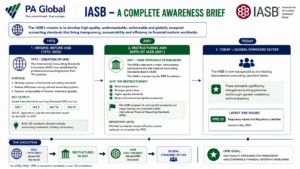
The International Accounting Standards Board (IASB) is an independent global standard-setting body responsible for developing International Financial Reporting Standards (IFRS). Established in 2001 and headquartered in London, the IASB succeeded the International Accounting Standards Committee (IASC), which was founded in 1973 and issued its first standard in 1975 (IAS 1: Presentation of Financial Statements).
Operating under the oversight of the IFRS Foundation, the IASB issues high-quality, globally accepted accounting standards that govern the preparation and presentation of financial statements worldwide. These standards provide a common financial reporting language used by entities in more than 140 jurisdictions, enhancing transparency, comparability, and investor confidence across international markets.
The IFRS framework comprises both International Accounting Standards (IAS), issued prior to 2001 (up to IAS 41), and International Financial Reporting Standards (IFRS), which have been issued by the IASB since April 2001. Together, these standards form a comprehensive and evolving set of principles-based accounting requirements applied globally.
IASB’s Global Role & Purpose
The IASB’s mission is to develop high‑quality, understandable, and enforceable accounting standards that bring consistency and comparability to financial statements globally. Its work supports investors, regulators, lenders, and other stakeholders in making informed economic decisions based on reliable financial information.
By creating a single set of globally accepted accounting standards, the IASB reduces reporting fragmentation and strengthens trust in international capital markets.
What the IASB Actually Does
The IASB’s core responsibilities include:
- Developing and issuing International Financial Reporting Standards (IFRS).
- Updating and improving existing standards to reflect evolving business models and economic realities.
- Issuing exposure drafts and consultation papers for public feedback.
- Working with regulators, national standard‑setters, and stakeholders worldwide.
- Supporting consistent application of IFRS through interpretations and guidance.
Through these activities, the IASB ensures that financial reporting remains relevant, transparent, and globally aligned.
Why IASB Matters Today
In a global economy where investors compare companies across countries and industries, consistent financial reporting is essential. IASB standards help ensure:
- Comparable financial statements across jurisdictions.
- Greater transparency and investor confidence.
- Reduced reporting complexity for multinational organizations.
- Improved capital allocation and market efficiency.
IFRS, developed by the IASB, has become the foundation of financial reporting in most capital markets worldwide.
How IASB Standards Work in Practice
IASB standards define how organizations recognize, measure, present, and disclose financial information in their financial statements. These standards cover areas such as:
- Financial instruments, revenue, leases, and consolidation.
- Measurement of assets, liabilities, income, and expenses.
- Disclosure requirements to enhance transparency and comparability.
IFRS are adopted or required by regulators in many jurisdictions, while others align their national standards closely with IASB requirements.
Reference:
www.Ifrs.org
https://jttaccountingservices.com/the-role-of-international-accounting-standards-board-iasb/
© 2026 PA Global. All rights reserved.