We deliver local knowledge backed by global strength.
With presence across the continents, we enable our member firms to deliver services that are locally relevant and globally aligned with international standards.

Our Network
Our Network

Insights
Insights
Business Insights providing executives with straightforward and strategic perspectives on key challenges: reshaping business models, addressing climate change and sustainability, and cultivating trust amidst rapid technological advancements.
All Insights
Services
Services
Our collaborative and transparent service portfolio includes assurance, business advisory, tax compliance and planning, risk assessment, and technology services. We prioritize integrity, objectivity, and confidentiality. With personalized strategies, we excel in meeting diverse client needs through a client-centric and proactive approach.
All Services
Industries
Industries
At PA Global, we stand as your reliable partner in navigating today’s complex and evolving business landscape. Our team of seasoned professionals brings deep industry expertise and a commitment to delivering tailored, forward-thinking solutions that empower organizations to grow sustainably and operate with resilience.
All Industries


 PA Academy
 Members Portal
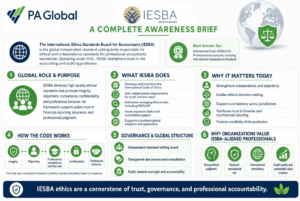
The International Ethics Standards Board for Accountants (IESBA) is the global independent standard‑setting body responsible for establishing ethical and independence standards for professional accountants worldwide. Operating under the auspices of the International Federation of Accountants (IFAC), IESBA serves the public interest by strengthening trust in the accounting and auditing profession.
IESBA is best known for issuing the International Code of Ethics for Professional Accountants (including International Independence Standards), which sets the global benchmark for ethical behavior across the profession.
IESBA’s Global Role & Purpose
IESBA’s mission is to develop high‑quality ethical standards that promote integrity, objectivity, professional competence, confidentiality, and professional behavior among accountants and auditors worldwide. These standards are designed to support public trust in financial reporting, assurance, and professional judgment.
By providing a globally consistent ethical framework, IESBA helps ensure that professional accountants act in the public interest, regardless of jurisdiction, sector, or role.
What IESBA Actually Does
IESBA’s work focuses on strengthening ethical conduct across the profession through:
- Developing and maintaining the International Code of Ethics for Professional Accountants.
- Establishing independence requirements for audit, review, and assurance engagements.
- Addressing emerging ethical risks, including Non‑Compliance with Laws And Regulations (NOCLAR).
- Issuing exposure drafts and consultation papers to gather global stakeholder input.
- Supporting consistent adoption and application of ethical standards worldwide.
These activities ensure that ethical principles evolve in line with business complexity and societal expectations.
Why IESBA Matters Today
In an environment of increased regulatory scrutiny, complex business structures, and heightened public expectations, ethical failures can severely damage trust in the profession. IESBA standards help safeguard against this by ensuring:
- Strong independence and objectivity in audit and assurance engagements.
- Clear guidance for resolving ethical dilemmas.
- Consistent ethical behavior across public practice, business, and the public sector.
- Reinforced confidence in financial and non‑financial reporting.
IESBA’s role is central to protecting the credibility of the global accountancy profession.
How the IESBA Code Works
The International Code of Ethics is principles‑based and built around five fundamental principles:
- Integrity
- Objectivity
- Professional competence and due care
- Confidentiality
- Professional behavior
The Code applies a conceptual framework requiring professional accountants to identify, evaluate, and address threats to compliance with these principles, including independence threats for auditors.
IESBA’s Governance & Global Structure
IESBA operates as an independent standard‑setting board with strong public‑interest oversight. Its standards are developed through a transparent due‑process model that includes global consultation, advisory input, and public accountability mechanisms.
This governance framework ensures that ethical standards remain credible, independent, and globally accepted.
Why Organizations Value IESBA‑Aligned Professionals
Organizations rely on professionals who follow IESBA standards because they demonstrate:
- Strong ethical judgment and independence.
- Consistent professional conduct across jurisdictions.
- Reduced ethical and reputational risk.
- Alignment with regulators, audit standards, and international best practices.
IESBA‑aligned ethics are a cornerstone of audit quality, governance, and sustainable value creation
© 2026 PA Global. All rights reserved.