We deliver local knowledge backed by global strength.
With presence across the continents, we enable our member firms to deliver services that are locally relevant and globally aligned with international standards.

Our Network
Our Network

Insights
Insights
Business Insights providing executives with straightforward and strategic perspectives on key challenges: reshaping business models, addressing climate change and sustainability, and cultivating trust amidst rapid technological advancements.
All Insights
Services
Services
Our collaborative and transparent service portfolio includes assurance, business advisory, tax compliance and planning, risk assessment, and technology services. We prioritize integrity, objectivity, and confidentiality. With personalized strategies, we excel in meeting diverse client needs through a client-centric and proactive approach.
All Services
Industries
Industries
At PA Global, we stand as your reliable partner in navigating today’s complex and evolving business landscape. Our team of seasoned professionals brings deep industry expertise and a commitment to delivering tailored, forward-thinking solutions that empower organizations to grow sustainably and operate with resilience.
All Industries


 PA Academy
 Members Portal
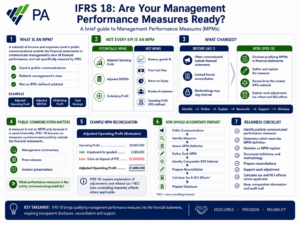
IFRS 18: Are Your Management Performance Measures Ready?
19 AUG 2026
Assurance
Reporting Standards
A Brief Guide for Entities to present and disclose their financial performance
Introduction
IFRS 18 – Presentation and Disclosure in Financial Statements, introduces specific disclosure requirements for Management-Defined Performance Measures (MPMs).
Many entities already communicate measures such as Adjusted Operating Profit, Adjusted EBITDA, Underlying Profit or Core Earnings outside their financial statements.
The major change is that, when such a measure meets the IFRS 18 definition of an MPM, information about it must now be disclosed within the financial statements, together with reconciliation and supporting explanations.
For accountants, this means moving from simply calculating a management performance measure to formally identifying, defining, reconciling, documenting and supporting it.
1. What Is an MPM?
Under IFRS 18, an MPM is a subtotal of income and expenses that:
- is used in public communications outside the financial statements;
- communicates management’s view of an aspect of the financial performance of the entity as a whole; and
- is not a subtotal specifically required by IFRS Accounting Standards or otherwise excluded by IFRS 18.
Examples that may be MPMs
- Adjusted Operating Profit
- Adjusted EBITDA
- Underlying Profit
- Core Earnings
The name of the measure alone does not determine whether it is an MPM. The accountant must assess whether the measure meets the IFRS 18 definition.
Not every *KPI is an MPM
| Measure | MPM? |
|---|---|
| Adjusted Operating Profit** | Potentially Yes |
| Adjusted EBITDA** | Potentially Yes |
| Underlying Profit** | Potentially Yes |
| Revenue growth % | No |
| Free Cash Flow | No |
| Return on Equity | No |
| Number of customers | No |
| Operating Profit | No – IFRS-defined subtotal |
| Gross Profit | No |
* KPI: Key Performance Indicator.
** Provided the measure meets the IFRS 18 definition of an MPM.
2. IAS 1 vs IFRS 18: What Changes?
| IAS 1 – Before | IFRS 18 – Now |
|---|---|
| Adjusted Operating Profit: $23m | Adjusted Operating Profit: $23m |
| Could be communicated outside the financial statements. | If it qualifies as an MPM, related information is disclosed in the financial statements. |
| Calculation might be explained only in management reporting. | Formal definition and explanation are required. |
| No specific IAS 1 MPM reconciliation framework. | Reconciliation to the most directly comparable IFRS subtotal is required. |
| Limited formal requirements concerning adjustments. | Each reconciling item must be disclosed and explained. |
| Tax and NCI effects were not subject to an MPM-specific IAS 1 framework. | Tax and NCI effects of reconciling items are required. |
| Calculation methodology might be maintained internally. | Method and significant changes must be transparent and supported. |
The key change
Before: Calculate and communicate the measure.
Now: Identify → Define → Explain → Reconcile → Support → Disclose.
3. Visual Example: Adjusted Operating Profit
Assume management publicly uses Adjusted Operating Profit to communicate its view of underlying operating performance.
| IAS 1 | IFRS 18 | ||||||||||||||||||||||||||||||
|---|---|---|---|---|---|---|---|---|---|---|---|---|---|---|---|---|---|---|---|---|---|---|---|---|---|---|---|---|---|---|---|
The measure might have appeared in an investor presentation or management report with limited explanation of the adjustments. |
The financial statement note must also provide the required information explaining the MPM, including the aspect of performance it communicates and how it is calculated, together with the required information about reconciling items and their tax and NCI “Non Controlling Interest” (also called minority interest) effects where applicable. * Management should calculate the income tax expense effect accordingly to the applicable rates in the country (i.e. Lebanon income tax is 17%) |
4. Visual Example: Adjusted EBITDA
IAS 1 – Typical Communication
| USD | |
|---|---|
| Adjusted EBITDA | 40,000,000 |
The measure could have been publicly communicated without an IFRS-specific MPM note explaining the complete bridge.
IFRS 18 – If the Measure Qualifies as an MPM
| Reconciliation | USD |
|---|---|
| Profit before tax | 30,000,000 |
| Add: | |
| Interest | 1,000,000 |
| Depreciation | 5,000,000 |
| Amortisation | 2,000,000 |
| EBITDA | 38,000,000 |
| Add: Restructuring expense | 2,000,000 |
| Adjusted EBITDA | 40,000,000 |
The accountant must be able to support:
- the definition of Adjusted EBITDA;
- how the measure is calculated;
- why management uses it;
- each reconciling adjustment;
- the required tax effects;
- the required NCI effects, where applicable; and
- comparative information.
5. Public Communication Matters
A performance measure does not become an MPM simply because management calculates it internally.
IFRS 18 focuses on measures used in public communications outside the financial statements.
Examples of public communications include management commentary; press releases; and investor presentations.
Therefore, accountants need more visibility than the year-end financial statements.
Accountant’s new question:
What performance measures is the entity communicating publicly?
The finance team should therefore coordinate with investor relations, management and communications teams to identify potential MPMs before preparing the financial statements.
6. How Should the Accountant Prepare?
The process should follow this sequence:
Public Communications → Identify Performance Measures → Determine Which Meet the MPM Definition → Define Each MPM → Identify Most Directly Comparable IFRS Subtotal → Prepare Reconciliation → Calculate Tax and NCI Effects → Prepare Comparative Information → Prepare IFRS 18 MPM Disclosure
7. Maintain an MPM Register
A practical MPM register could contain:
| MPM | Public Source | IFRS Reference Point | Adjustments | Tax Effect | NCI Effect | Owner |
|---|---|---|---|---|---|---|
| Adjusted Operating Profit | Investor presentation | Operating Profit | Impairment for goodwill / Gains on sale of PPE | ✔ | ✔ if applicable | Finance |
| Adjusted EBITDA | Earnings release | Most directly comparable IFRS subtotal | D&A / restructuring | ✔ | ✔ if applicable | Finance |
The register should help ensure that the measures disclosed in the financial statements are consistent with the measures management communicates publicly.
8. Accountant Readiness Checklist
Before IFRS 18 becomes effective, accountants should:
- identify performance measures used in public communications;
- determine which measures meet the IFRS 18 definition of an MPM;
- maintain an MPM register;
- formally define each MPM;
- document why management uses the measure;
- document the calculation methodology;
- identify the most directly comparable IFRS subtotal;
- prepare the required reconciliation;
- support each reconciling adjustment;
- calculate the required tax effects;
- calculate NCI effects where applicable;
- prepare comparative information;
- document changes in MPMs or calculation methodology; and
- maintain a clear audit trail supporting the disclosure.
Under IAS 1, management performance measures could largely sit outside the IFRS financial statement framework.
Under IFRS 18, when a performance measure qualifies as an MPM, the accountant must bring transparency around that measure into the financial statements.
The accountant’s responsibility is therefore no longer simply:
“How did we calculate this number?”
It becomes:
“Why do we use it, where did it come from, how does it reconcile to IFRS, and can every adjustment be supported?”
IFRS 18 turns qualifying management performance measures from externally communicated numbers into formally disclosed and supportable financial information.
© 2026 PA Global. All rights reserved.