We deliver local knowledge backed by global strength.
With presence across the continents, we enable our member firms to deliver services that are locally relevant and globally aligned with international standards.

Our Network
Our Network

Insights
Insights
Business Insights providing executives with straightforward and strategic perspectives on key challenges: reshaping business models, addressing climate change and sustainability, and cultivating trust amidst rapid technological advancements.
All Insights
Services
Services
Our collaborative and transparent service portfolio includes assurance, business advisory, tax compliance and planning, risk assessment, and technology services. We prioritize integrity, objectivity, and confidentiality. With personalized strategies, we excel in meeting diverse client needs through a client-centric and proactive approach.
All Services
Industries
Industries
At PA Global, we stand as your reliable partner in navigating today’s complex and evolving business landscape. Our team of seasoned professionals brings deep industry expertise and a commitment to delivering tailored, forward-thinking solutions that empower organizations to grow sustainably and operate with resilience.
All Industries


 PA Academy
 Members Portal
IFRS 18: Disclosure of accounting policies: A Brief Guide for Accountants
8 SEP 2026
Assurance
Reporting Standards
Less Boilerplate, More Material Accounting Policy Information
IFRS 18, Presentation and Disclosure in Financial Statements, brings major changes to financial statement presentation, but its effect on accounting policy disclosures is more subtle.
The move away from lengthy, standardized accounting policies actually began before IFRS 18, when IAS 1 was amended to require disclosure of “material accounting policy information” rather than simply “significant accounting policies” as of 2023
With IFRS 18 replacing IAS 1, these requirements are carried forward and reorganized within the revised presentation framework and IAS 8.
For accountants, the practical message is straightforward:
Do not disclose an accounting policy simply because an IFRS Standard applies. Disclose the policy information users need to understand the entity’s material transactions, events and conditions.
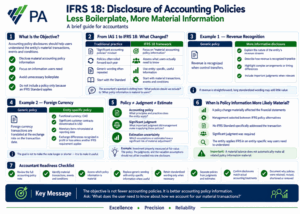
From Traditional Practice to the New Framework
| Traditional IAS 1 Practice | IFRS 18 / IAS 8 Approach |
| Disclose a broad set of significant accounting policies. | Focus on “material accounting policy information”. |
| Policies often repeat IFRS wording. | Focus on information relevant to the entity’s own circumstances. |
| An applicable IFRS Standard often resulted in a policy paragraph. | An applicable Standard does not automatically mean the related policy information is material. |
| Long generic policies could obscure important information. | Immaterial policy information should not obscure material policy information. |
| Question: “Does this policy apply?” | Question: “Do users need this policy information to understand material information in our financial statements?” |
The accountant’s mindset is changing:
Before: What accounting policies should we include?
Now: What accounting policy information is material to users?
Example 1 — Revenue Recognition
Consider a company providing software implementation services.
| Generic / Boilerplate | Material & Entity-Specific |
| Revenue is recognized when control of goods or services transfers to the customer in accordance with IFRS 15. | Revenue from software implementation services is recognized over time because the customer receives the benefits as the services are performed. Progress is measured using project milestones that reflect completion of the implementation work. |
| Mainly repeats IFRS 15. | Explains how the entity actually recognizes its material revenue stream. |
The second disclosure gives the user information about the entity rather than simply describing the accounting standard.
Accountant impact
When reviewing revenue policies, ask:
What does the user need to know about how we recognize revenue?
If revenue is straightforward and the generic policy adds nothing to the understanding of material information, extensive standardized wording may not be necessary.
If revenue involves complex arrangements, different recognition patterns or important judgments, entity-specific information becomes much more relevant.
Example 2 — Foreign Currency
Generic Policy
Foreign currency transactions are translated using the exchange rate at the date of the transaction.
Correct — but potentially not very informative.
Entity-Specific Policy
The entity’s functional currency is the Canadian Dollars (CAD). A significant portion of customer contracts is denominated in USD. Foreign-currency monetary items are retranslated at the reporting-date exchange rate, with resulting exchange differences recognized in profit or loss, unless another IFRS requirement specifies otherwise.
| Generic | Entity-Specific |
| Explains the general accounting mechanics. | Explains why foreign currency accounting matters to this entity. |
| Could apply to thousands of companies. | Connects the policy to the entity’s actual currency exposure. |
| Primarily repeats IAS 21. | Helps users understand a material aspect of the financial statements. |
The objective is not simply to make the disclosure longer or shorter. It is to make it useful.
Example 3 — Fair Value
Suppose an entity holds significant investment property.
| Generic / Boilerplate | More Informative |
| Investment properties are measured at fair value. | Investment properties are measured at fair value. Where directly comparable market transactions are limited, valuation incorporates market evidence and discounted cash-flow techniques appropriate to the property. |
| States the measurement basis. | Explain how the policy is applied in the entity’s circumstances. |
This becomes particularly relevant when accounting involves significant judgment, complex measurement or entity-specific application.
However, accountants should avoid turning the accounting policy note into the entire judgment or valuation disclosure.
Policy ≠ Judgment ≠ Estimate
These concepts are related, but they are not the same disclosure.
Accounting Policy
→ What principles and practices does the entity apply?
Significant Judgment
→ What important judgment did management make in applying those policies?
Estimation Uncertainty
→ Which assumptions or estimates have a significant risk of causing material adjustment?
For example:
Policy: Investment property is measured at fair value.
Entity-specific application: Certain properties require valuation techniques because directly comparable market transactions are limited.
Detailed information about significant judgments, valuation assumptions and estimation uncertainty should then be provided under the relevant disclosure requirements rather than unnecessarily loading everything into the accounting policy.
So, Which Policies Are More Likely to Be Material?
Accounting policy information may be particularly relevant where:
- the entity changed an accounting policy and the change materially affected the financial statements;
- management selected between accounting policy alternatives permitted by IFRS;
- no IFRS Standard specifically addressed the transaction and management developed an accounting policy;
- significant judgment was required in applying the accounting policy; or
- the entity applies an IFRS requirement in an entity-specific way that users need to understand.
But there is an important warning:
A material balance does not automatically make all related accounting policy information material.
Materiality must be considered for the policy information itself.
What Should Accountants Do Now?
Start with the existing accounting policy note. For each policy, ask:
- Why is this policy here? Is it included because users need it, or because it has always been there?
- Does it explain our accounting? Or does it simply reproduce IFRS wording?
- Is the information material? Would users need it to understand other material information in the financial statements?
- Can it be more entity-specific? Explain how the policy applies to the entity’s actual transactions and circumstances.
- Is boilerplate obscuring useful information? Longer does not necessarily mean better.
Do Not Simply Delete Boilerplate
The objective is not to produce the shortest possible accounting policy note.
Standardized information can still be material where users need it to understand complex accounting.
Therefore:
- Boilerplate + no useful information → reconsider
- Entity-specific + material information → retain
- Standardized information necessary to understand complex accounting → may still be appropriate
- Material information hidden by excessive detail → reorganize or simplify
Accountant Readiness Checklist
Before IFRS 18 becomes effective:
- Review the complete accounting policy note rather than automatically rolling it forward.
- Identify the entity’s material transactions, events and conditions.
- Assess which related accounting policy information is material.
- Remove the assumption that every applicable IFRS Standard requires its own policy paragraph.
- Replace generic wording with entity-specific information where useful.
- Retain standardized information where it is genuinely necessary to understand complex accounting.
- Ensure immaterial policies do not obscure material information.
- Separate accounting policies from significant judgments and estimation uncertainty disclosures.
- Confirm that disclosed policies match the accounting treatments actually applied.
- Document why policies were retained, revised, shortened or removed.
The Key Message
The objective is not:
Fewer accounting policies.
It is:
Better accounting policy information.
For accountants, the shift is from asking:
“Which IFRS policies should we reproduce?”
to asking:
“What does the user need to know about how we account for our material transactions?”
That is the direction of accounting policy disclosure under the IFRS 18 framework and related IAS 8 requirements.
© 2026 PA Global. All rights reserved.